
 Vijay Singh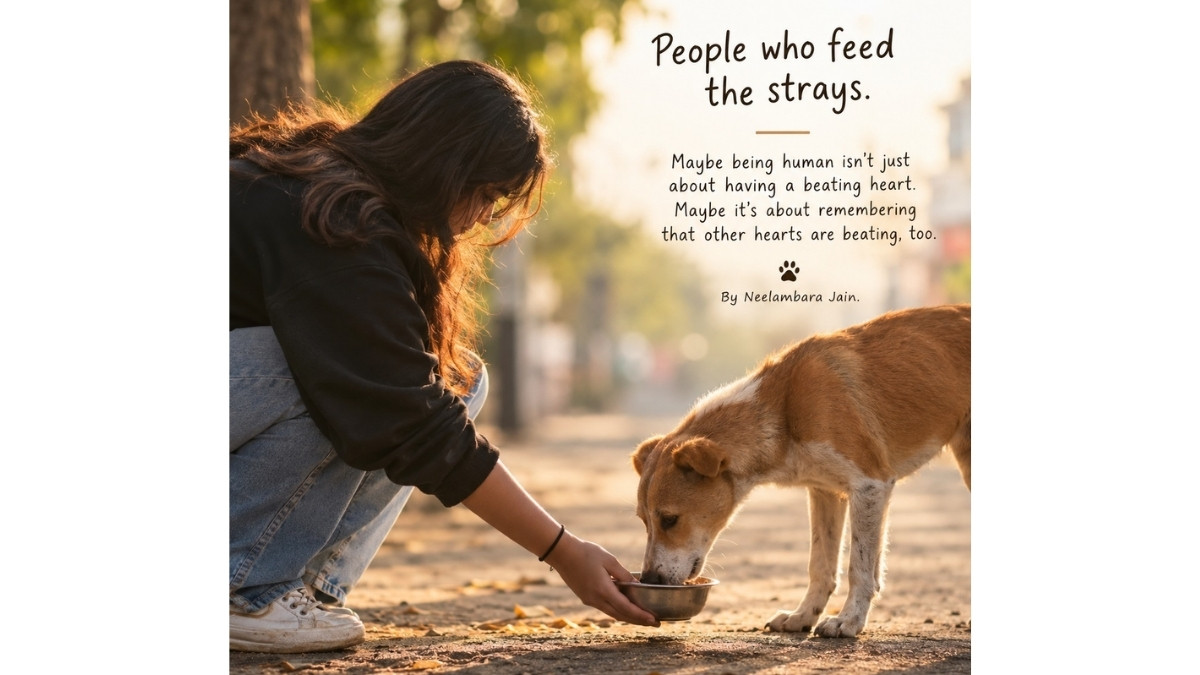
New Delhi [India], October 13: In a world increasingly dominated by technological advancements and automated intelligence, a quiet, grassroots movement of urban compassion is unfolding daily across city streets. At the heart of this movement are ordinary individuals who pause during their daily routines to feed stray animals—a simple act that advocates argue captures the true essence of human empathy.
In an original commentary, student writer and young creative Neelambara Jain explores the profound impact of these unsung street caregivers and questions what it genuinely means to be human in modern society.
“Maybe being human isn’t just about having a beating heart,” writes Jain. “Maybe it’s about remembering that other hearts are beating, too.”
The Reality of Street Survival
For millions of street animals, every day is a relentless search for basic sustenance. While domesticated pets enjoy scheduled meals and comfortable homes, stray dogs navigate hostile urban environments where food security is non-existent.
Human interest studies and animal welfare observations consistently highlight a remarkable biological phenomenon: the lasting memory of street dogs. A single act of kindness—offering food just once—often establishes a long-term bond of recognition and trust between a stray animal and a human passerby. Welfare advocates describe this intuitive connection as a powerful testament to the emotional intelligence shared across species.
Redefining Kindness in Modern Society
Contemporary culture frequently reduces the concept of kindness to basic polite interactions or standard civic etiquette. However, community animal feeders demonstrate a deeper, active form of empathy—one that advocates for living beings that cannot verbally request help.
These daily caregivers represent a diverse demographic:
- Lifelong Animal Lovers: Individuals with a history of pet ownership and animal advocacy.
- First-Time Caregivers: Citizens who simply noticed a hungry animal and chose to act.
- Community Volunteers: Residents who quietly integrate animal care into their morning and evening commutes.
Regardless of their background, these individuals share a common recognition: that a stray animal possesses the same fundamental needs and biological capacity for suffering as any other living creature.
A Stark Contrast to the AI Era
Jain’s commentary highlights a striking paradox of 21st-century civilization. As global technology industries spend billions teaching artificial intelligence and robotics to emulate human thought, speech, and creativity, everyday human society risks neglecting foundational empathetic behaviors.
The act of feeding a stray serves as a subtle counter-movement, proving that humanity is defined less by technological innovation and more by the capacity for active care.
A Call to Action for Urban Communities
Animal welfare groups and community advocates encourage citizens to participate in local street care initiatives. Simple steps include:
- Carrying Basic Food Supplies: Keeping small portions of animal-safe food or biscuit packets during daily walks.
- Supporting Local Caregivers: Assisting neighborhood feeders with resources or hydration stations during extreme weather.
- Promoting Humane Coexistence: Encouraging community awareness regarding stray animal welfare and spay/neuter programs.
About the Author
Neelambara Jain is a Grade 11 student, writer, and multi-disciplinary artist. Beyond her literary work, she shares classical and contemporary guitar performances under the handle @amberneonxo on Instagram. She is also the creator behind @sapphireediaries, a global venture focused on handcrafted art and jewelry design. Through her writing and creative projects, Jain aims to explore themes of social empathy, artistic expression, and youth perspectives on modern living.
Views expressed above are the author’s own and do not reflect the publication’s views.