 Vijay Singh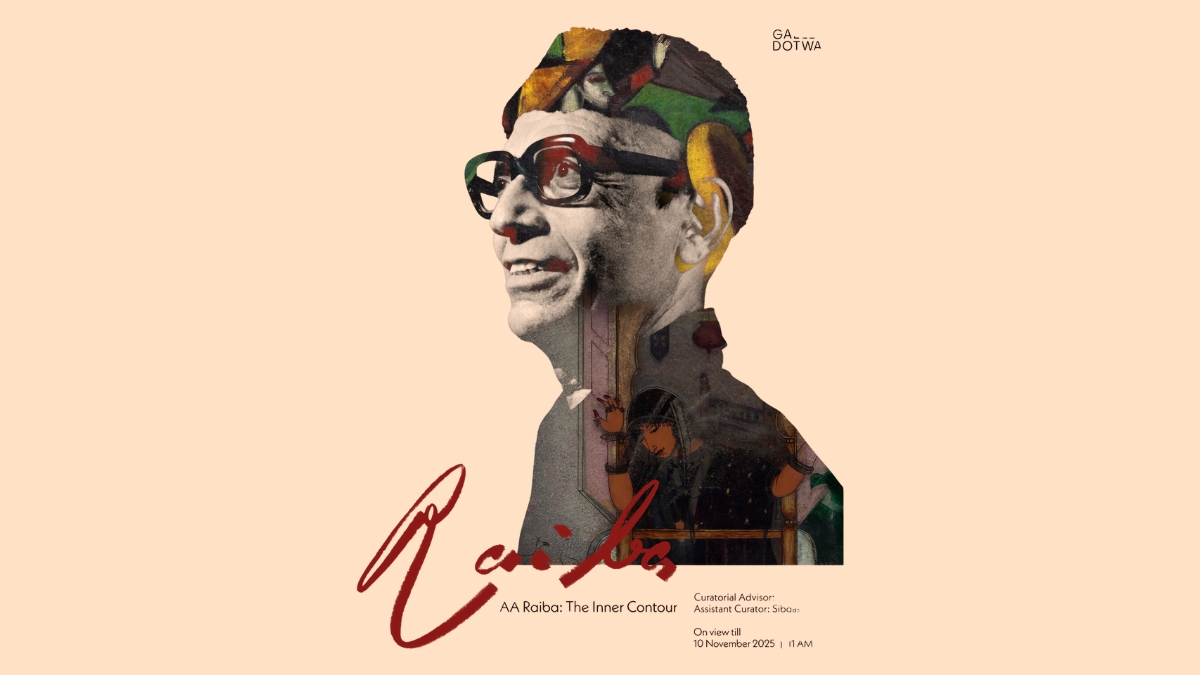
New Delhi [India], October 29: Another outstanding event will take place in the capital city, A. A. Raiba: The Inner Contour, the artistic practice of one of the early modern Indian artists, Abdul Aziz Raiba (1922–2016), will be organised by the Gallery Dotwalk, the art gallery based in the NCR. The preview of the exhibition would be organised on 1st November 2025, 6 PM at Travancore Palace, New Delhi, and it would be open to the people throughout the period between 2nd nd 10th November 2025, 11 AM to 6 PM. R. Siva Kumar, renowned Art Historian and Curator, will work as Curatorial Advisor.
This massive show is a compilation of the early works of Raiba, a collection of works of numerous drawings, experimental works, artist books, and photographs of his archives, which takes us back to his early years of academia training in the Sir J. J. School of Art and his subsequent journeys through Kashmir and other places, which helped him to change and discover his own way of doing things.
Talking about the exhibition, Sreejith CN, Founder of Gallery Dotwalk, commented, “We are pleased to introduce one of the most recognisable voices of modern Indian art. This exhibition follows the development of the visual language of Raiba and reflects the changes and continuities of his art. This exhibition allows the Gallery Dotwalk to show its recent acquisition of the body of work of Raiba, which is a visual delight to art connoisseurs. This exhibition is not just the display of works, but a personal adventure in the inner world of Raiba, his discipline, his endurance, and his amazing skills to turn material restrictions into the power of art. We feel that his story will touch many a note with experienced collectors and even novices, and reassert the role of Raiba in the history of Indian modernism.
The exhibition puts the contribution of A.A. Raiba to Indian Modernism into perspective by examining his authoritative use of the line. The vision of the exhibition that has been adopted by the curator places greater emphasis on the use of contour as a formal theme of the exhibition. In the traditional arts, the contour is a limitation, and in the exhibition, Raiba uses crisp and lyrical contour lines, which can be presented as a powerful philosophical and formal edge, and can be found in subjective experience in visual terms. This profile is a conscious, often dusky line that at the same time isolates the figure and identifies it inevitably with the cultural landscape around the subcontinent.
The bold form and robust outlines are specifically the features of the oeuvre of Raiba- the sharp shift in the style, his introduction into the modern environment, though his early education was in the traditionally fragile Indian miniature painting. His artistic individuality was manifested in his conscious departure from the Miniature technique using daring forms and outlines. Its curatorial vision suggests repositioning Raiba as a subsidiary character into a lead protagonist whose distinct sensibility was developed by an act of rigorous self-directed investigations of form, material and cultural vocabulary.
An extraordinary impact on the mastery of the line by Raiba was the close attachment to the Islamic literature and Urdu poetry. His early taste in Urdu prompted him to indulge in Arabic calligraphy, a line of arts which involves no less rigid discipline than absolute control, precision, and the communication of a deep meaning by the correctness of the stroke. This was a lifelong habit of calligraphy that gave the technical mechanism of the “Inner Contour”, which gave his contours a fragrance of authority and spirituality. This proficiency is also clear in his self-designed exhibition invitations, whereby he tended to incorporate Arabic couplets and elaborate designs and morph into a bird form at some point. This subject made his line always full of intellectual and spiritual purpose.
One more important aspect that predetermined the boldness of the contour was the resourceful use of the materials by Raiba. Raiba, having been brought up in association with the tailor shop of his father, made use of unusual canvas, such as fragments of sarees, jute cloth, and finally, he even learned the tricky art of painting on jute. When one did not want the form to be lost, painting on so rough and absorbent a surface, strokes had to be strong and decisive. The radical edging in this way transformed not only into a technical imperative but also a signature style, a way for Raiba to show his self-sufficiency, his innovativeness, and his ability to bring something tactilely modern.
There are also the archived materials, films and research documentation that give a multi-layered understanding of the philosophy and process of Raiba in the exhibition. These indicate his systematic interest in the mundane as a field of art. This exhibition makes Raiba a unique giant among Indian modernism, a radical artist whose course was characterised by non-conformity. The bold line, then, is not a shallow style, and in fact, it is a manifesto of modernist spirit by Raiba himself, which enabled him to be conceptually modern and structurally assertive without being alluded to the dominant European post-Impressionist or academic standards that pervaded his peers.
A. A. Raiba: The Inner Contour attempts to discuss how the personal and the cultural terrain of the artist contributed towards his artistic development. The curatorial story is presented in various stages of the journey of Raiba, where each stage of change in his visual sensibility takes place. This exhibition places Raiba as not only a key player in the Indian modernism of the post-Independence period but also an artist who deliberately stayed outside the mainstream art historical paradigms to shape an independent course based on the sensory, material interest, and inwardness.